Why Fleet AI Needs a Knowledge Graph
Most AI in fleet management today does pattern matching. Show a maintenance log to a language model and it can summarize it. Show a list of invoices and it can spot duplicates. Show a list of vehicles and it can recommend which ones look like outliers. These are useful tricks, but they hit a ceiling fast. The model can summarize the maintenance log, but it cannot tell you what that delay actually cost the contract, or which supplier is responsible, or what to do next.
The reason is not the model. The reason is what the model has been given to work with. Generic AI is reading a string of text; it does not know that the string is a vehicle that belongs to a contract that has an SLA with a customer whose CFO will see a missed-target notice tomorrow morning. That structure, the network of relationships behind the data, is what separates a trained AI eye from an untrained one. And the data structure that captures it is the knowledge graph.
The trained vs. the untrained AI eye
There is a useful distinction worth making early. An untrained AI eye sees data as text. It can describe what it sees, paraphrase it, classify it, and pull out keywords. What it cannot do is reason about the data the way an operator would, because it does not know how the pieces of an operation fit together.
A trained AI eye sees the same data through the lens of a domain model. It knows what an asset is, what a contract is, how the two connect, which suppliers touch the asset over its lifecycle, what failure modes happen in which order. When it looks at a delayed vehicle, it does not just see a row in a table; it sees a node in a graph with edges leading to a storage location, an outstanding inspection, an upstream OEM order, and a customer waiting on delivery. That visibility is what allows it to give an answer that an operator can act on.
The difference, in other words, between a trained AI and an untrained one is the knowledge graph behind it.
What a fleet knowledge graph actually is
A knowledge graph is a network of entities and the relationships between them. For fleet leasing, the entities look something like this: vehicles, contracts, customers, suppliers, workshops, inspections, invoices, OEM partners, financial institutions, storage facilities, transportation vendors, remarketing channels, and the events that connect them.
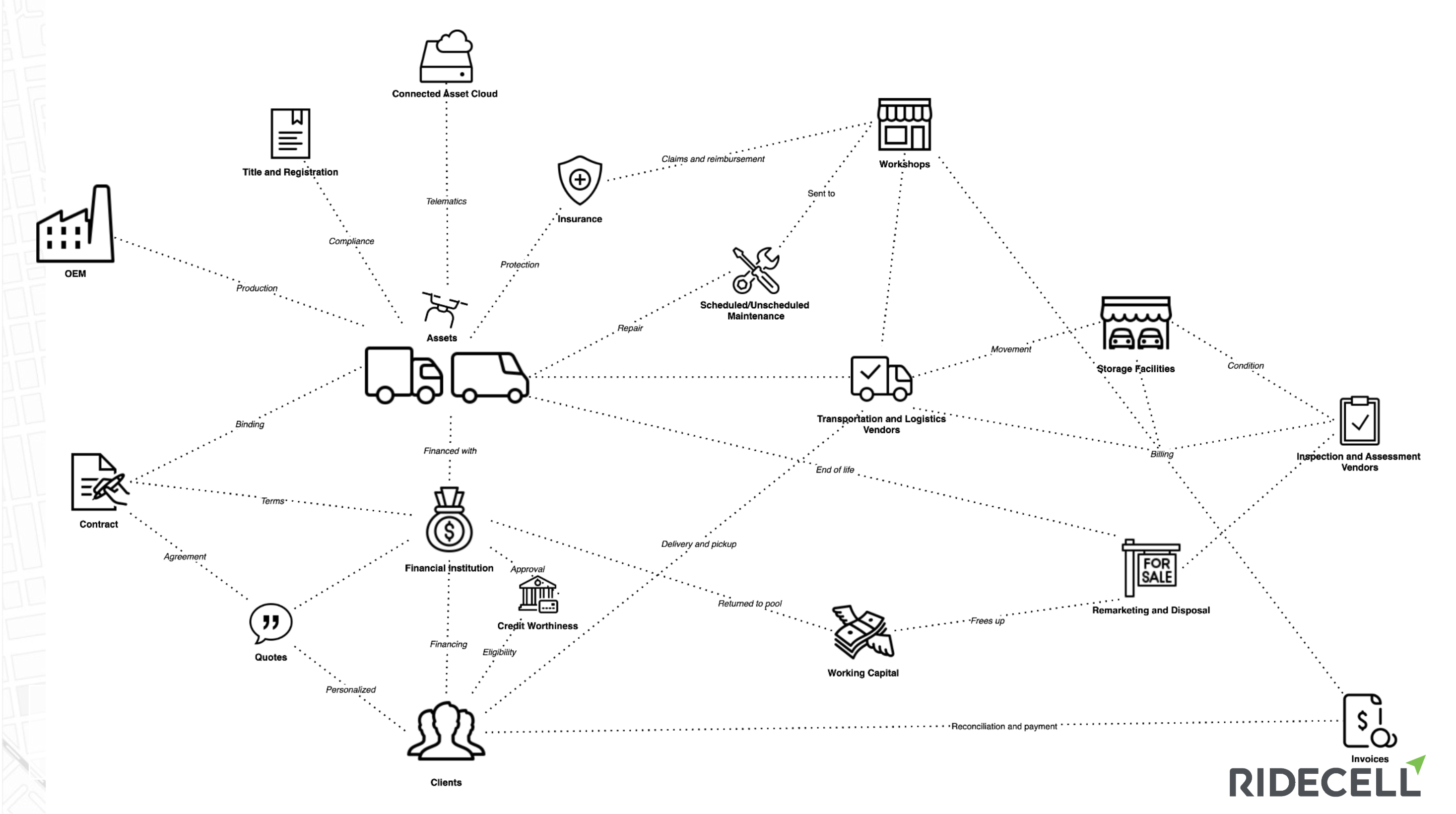
In the Ridecell knowledge graph today, there are multiple domain-specific entities, connected by real operational relationships rather than data joins. The “real operational” part matters. A data warehouse can give you a JOIN between two tables. A knowledge graph gives you the semantic edges: this vehicle is under maintenance with this workshop, which has historically missed turnaround on tires by 14 percent, which is causing a follow-on idle day, which trips the SLA with this customer. Each edge is a relationship the AI can traverse to answer a real question.
That traversal is the part that matters. It is why “why is this vehicle idle?” becomes answerable. The AI can walk: storage location, no completed inspection, workshop unavailable, upstream OEM delay, original PO date. The answer reads like an operator’s answer because the AI has the same map an operator does.
Why a data lake is not enough
Most fleets already have a lot of data in one place. The market spent the better part of a decade consolidating telematics, ERP, OEM portals, maintenance systems, and invoicing into data lakes. Plenty of dashboards came out of that work. AI tools layered on top did some genuinely useful things.
But a data lake is a pile of tables. It does not, by itself, encode that an invoice line refers to a job that was performed on a vehicle that is under a specific contract that has a specific customer who pays a specific rate. The relationships are implicit, scattered across foreign keys and pipeline scripts. Querying across them is brittle, and the AI sitting on top can answer flat questions but stumbles on the cross-cutting ones.
A knowledge graph is the layer that makes those relationships explicit. The 100-plus systems still feed in. The harmonization is the work. What comes out the other side is a single, queryable model of how the fleet actually works.
What the AI can do once it has one
The list of capabilities a knowledge-graph-backed AI unlocks is not exotic. It is the list of things operators have been asking for and not getting:
- Trace the root cause of an idle vehicle in seconds, not days, because the AI can follow the edges from the asset to its blockers.
- Validate every invoice against contract rates, telematics evidence, and historical patterns before payment, not after.
- Score suppliers continuously on cost, turnaround, and quality, with the comparisons grounded in the same operational events the suppliers performed.
- Predict where the next bottleneck will appear based on the structure of upcoming orders and the capacity of the workshops handling them.
- Notify the right client about the right delay with the right root cause, without an account manager stitching the story together.
Each of these requires traversing the graph. None of them work on a flat data table. The graph is not an accessory to the AI; it is what makes the AI useful.
Why this matters now
Generative AI has made the demand for “operational AI” explode. Every fleet leasing company is being asked to deploy it. Most of the off-the-shelf tools, though, are trained on the public internet, not on the operator’s data. The result is a chatbot that knows a lot about cars in general and almost nothing about this fleet in particular.
A knowledge graph is the missing layer. It is what turns a general-purpose model into a domain expert without retraining the model. And the investment compounds: every supplier, every contract type, every new process the graph encodes makes the AI smarter on every question it answers next.
The point
For fleet leasing companies, the practical question is not whether to invest in AI. That decision is already made. The question is whether the AI on the other side of the investment can actually see the fleet. The answer to that question lives in the knowledge graph.
If you would like to see how the Ridecell fleet knowledge graph maps to your data, the team would be glad to walk you through it.