Moving Beyond the “5% Productivity Trap”: How FMCs Are Turning to AI for Direct Margin Protection
There is a growing, uneasy conversation happening in boardrooms across the globe regarding the real-world return on artificial intelligence.
For the past two years, organizations have rushed to deploy AI, often defaulting to generalized, chat-style applications. While these tools undoubtedly spark individual moments of efficiency, improving a worker’s personal output by 5% or 10%, the broader financial reality remains stark: individual productivity gains do not automatically translate into organizational cost reductions. As a leading industry executive recently observed, a marginal increase in personal speed doesn’t let you reduce your overall headcount by 5% or 10%.
For Fleet Management Companies (FMCs) navigating high volume and tight margins (for example, on service, maintenance, and repair expenses), passive AI applications are a financial liability. True capital preservation requires moving away from speculative chat applications and shifting toward specialized solutions that integrate directly with front-line workflows to impact gross margins. Ridecell is at the forefront of addressing such problems by deploying auditable, deterministic solutions that enhance and automate the work done by front-line fleet and maintenance managers, delivering tangible business outcomes: reducing supplier costs and operating expenses.
Here we provide a blueprint for this transition, demonstrating how to bridge the gap between technical data collection and definitive corporate outcomes.
The Core Challenge: Codifying the “Unwritten Rules” of Fleet Triage
In fleet management, operational expertise is traditionally locked inside the minds of your most senior fleet and maintenance managers. They are the ones who intuitively know when a garage is over-servicing a vehicle, duplicate billing, or inflating hourly labor rates.
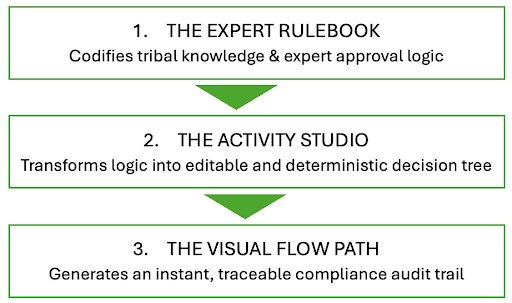
When more than 40% of maintenance quotes sent for intervention or approval require manual, human triage, operational fatigue sets in. An anomaly caught by a top-performing associate at 9:00 AM might easily be missed by a tired team member at 4:30 PM. To capture this unwritten institutional knowledge and apply it consistently at enterprise scale, Ridecell has introduced a three-pronged framework that brings AI directly into front-line operations.
A. The Expert Rulebook: Capturing Institutional Knowledge
Instead of forcing a maintenance team to interact with an unpredictable chat prompt, Ridecell begins by extracting the implicit expertise (the business rules) of an FMC’s top performers. This institutional knowledge, including custom pricing agreements, SLAs, warranty guidelines, and local market cost benchmarks, is codified into a structured, centralized Expert Rulebook. This ensures that your best practices are no longer tribal or localized; they are captured as a permanent, auditable corporate asset.
B. The Activity Studio: Driving Deterministic Execution
To guarantee that this captured knowledge yields reliable, predictable results, the Expert Rulebook is integrated directly into the Activity Studio. The platform automatically converts complex approval logic into clear, visual decision trees.
Once an operational workflow is locked down in the studio, the system’s decision-making becomes completely deterministic. By relying on strict business logic rather than variable algorithmic predictions, the system removes the traditional guessing game associated with generative models. If regional pricing or contract terms shift, operations leaders can update condition nodes within a self-serve UI in seconds, completely bypassing long, expensive software engineering cycles.
C. Complete Traceability: Eliminating the “Black Box” Problem
Handing enterprise financial decisions to an automated system requires absolute visibility. Ridecell completely solves the industry’s “black box” dilemma through its View Flow Path auditing engine.
When a work order is analyzed, such as a quote containing a pre-mature brake fluid replacement or an inflated parts line item, the engine systematically maps the decision trail. If the system rejects a specific line item, the front-line staff is not left guessing. With a single click, View Flow Path opens an instantaneous visual audit trail, highlighting the exact parameter, contract clause, or market threshold that triggered the exception.
Real-World Outcomes at the Front Line
By overlaying this deterministic intelligence directly onto existing workflows through a seamless browser extension, Ridecell meets fleet maintenance staff exactly where they already work. There is no disruptive UI shift, no separate chatbot tab to manage, and no threat to operational conversion speed.
The system acts with the blended speed, precision, and consistency of your best-performing human experts across 100% of incoming work orders. This approach delivers measurable P&L impact by enabling key business outcomes: reducing manual staff effort and minimizing operational expenses (OpEx), and most importantly, erasing cost leakages and reducing avoidable supplier costs through improved spend tracking and supplier performance benchmarking. This is how Ridecell brings AI out of the testing playground and onto the corporate balance sheet, by providing the concrete, traceable enterprise governance required to protect margins at scale.