Driving Trust: Why Data Sovereignty and LLM-Agnostic Design are critical pillars to the Future of Enterprise AI
The connected vehicle revolution has transformed fleet management from a logistical challenge into a data-driven science. Today, intelligent and connected vehicle platforms generate massive amounts of telemetry, driver behavior, and geolocation data (Zhao et al., 2020). However, for the world’s largest automotive leasing and financial services companies, this influx of data introduces a massive challenge: data sovereignty.
As AI integrates into mobility, controlling and protecting data is a business critical requirement. At Ridecell, building scalable fleet automation isn’t just about operational efficiency; it’s about architecting systems that inherently respect and meet the rigorous regulatory and security standards of Tier-1 financial institutions.
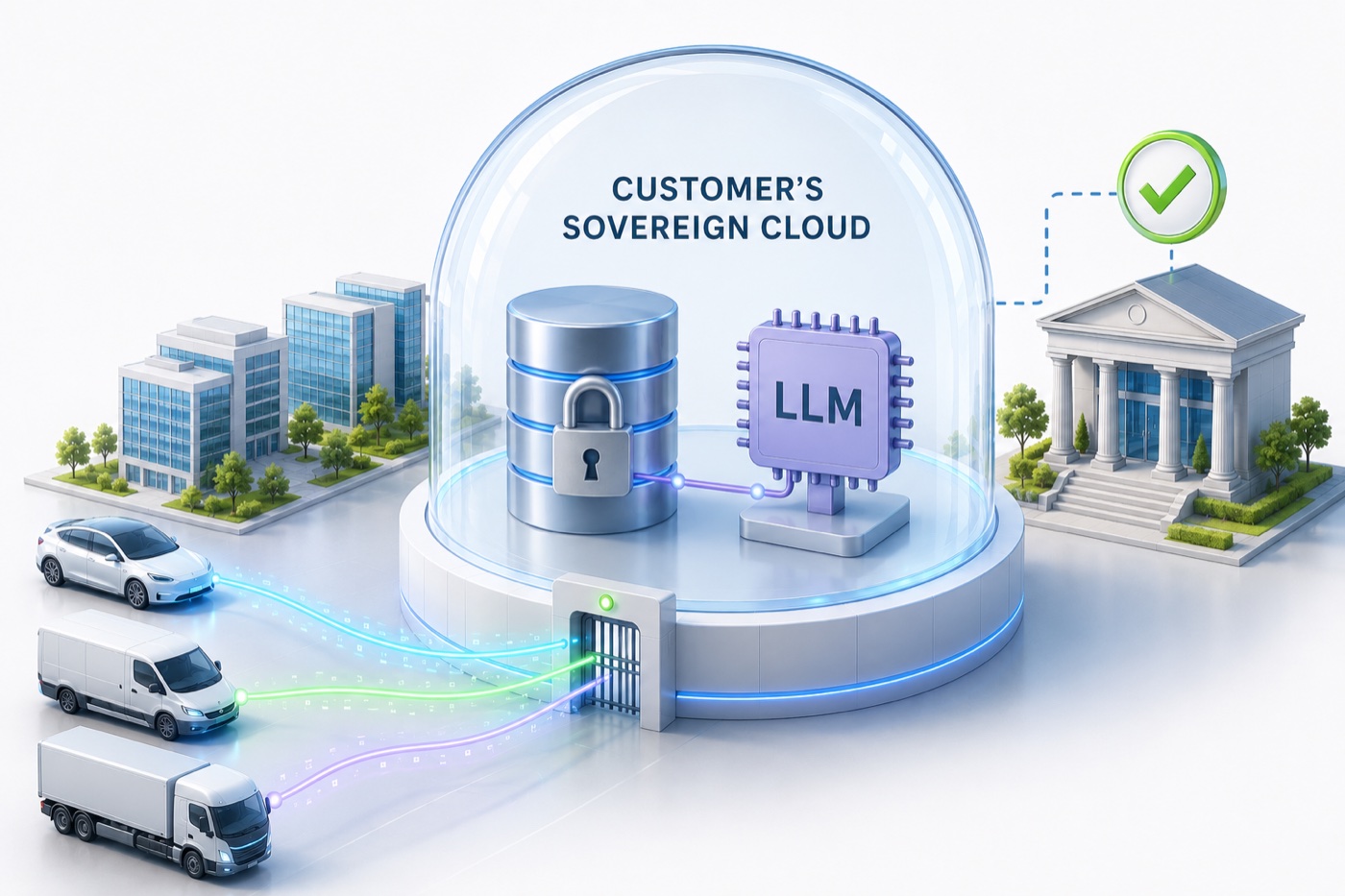
Our architecture enables data sovereignty through DMZ Customer VPC deployments, IBM Cloud for Financial Services certification, SOC 2 Type II certification and an LLM-agnostic design.
The Data Sovereignty Imperative for Fleet Finance
Big leasing and financial services companies aren’t just managing cars; they are managing billions of dollars in assets and highly sensitive consumer data. The financial arms of major OEMs (like those of BMW, VW, and Daimler) operate under the same strict regulatory scrutiny as traditional banks.
When a fleet vehicle transmits data, it is sending highly sensitive PII (Personally Identifiable Information) alongside proprietary operational metrics. While the digital economy treats data as fuel, the legal and regulatory frameworks surrounding data access and ownership are incredibly complex and heavily restricted to protect privacy (Determann, 2018). Relying on traditional multi-tenant SaaS architectures forces these leasing giants to hand over their most sensitive data to third-party servers, creating unacceptable risk profiles.
As one executive at a global fleet financing firm noted during a recent industry forum:
“Our fleet data is an extension of our financial ledger. We cannot afford to have telematics and driver information sitting in a shared cloud environment. If we don’t have absolute sovereignty over where our data lives and how it is processed, we cannot confidently lease the next generation of connected vehicles.”
Case Study: From Dedicated Tenancy to DMZ Sovereign Deployments
Ridecell has evolved its deployment strategies to match the security requirements of enterprise leasing.
The Foundation: Single-Tenant Implementations
Historically, Ridecell avoided the traditional multi-tenant SaaS trap by offering individual, dedicated implementations for each client. By providing single-tenant deployments, Ridecell ensured that a customer’s data was never co-mingled with another organization’s data. This approach was highly successful in establishing baseline privacy and security, allowing clients to bring their own encryption keys and maintain strict isolation.
The Next Step: Sovereign Deployments via Customer VPC and DMZ
Instead of routing data out to a Ridecell-controlled environment, the platform is deployed inside the customer’s cloud perimeter. This means the leasing company retains exclusive control over physical data localization, firewall configurations, and all network policies. The client’s own ingress and egress controls are applied to the platform exactly as they would be to any internal, proprietary system. If a European leasing company requires its data to stay strictly within Germany to comply with GDPR, the DMZ architecture guarantees it never crosses borders.
Building Trust with IBM FS Certification
Running inside a customer’s DMZ is a massive leap forward, but financial institutions require external validation. To alleviate all remaining data sovereignty concerns, Ridecell took the rigorous step of aligning its platform with the IBM Cloud for Financial Services (IBM FS) framework.
Earning specific IBM FS validation means the deployment architecture meets the banking industry’s highest standards for cybersecurity, compliance, and risk management. By combining the DMZ Sovereign model with IBM FS certification, Ridecell provided big leasing companies with the ultimate assurance: an agile, modern fleet management platform operating with the security posture of a Tier-1 bank.
Future-Proofing with LLM-Agnostic Design
Solving the data storage and perimeter control problem was only the first step. Today, the operational efficiency of fleet management is being radically accelerated by Artificial Intelligence, specifically Large Language Models (LLMs) that can analyze maintenance logs, automate driver communications, and predict leasing lifecycle events.
However, AI introduces a new data sovereignty nightmare. Sending proprietary fleet data outside the DMZ to public LLM APIs (like those offered by OpenAI or Google) defeats the purpose of a sovereign cloud, potentially violating privacy policies and exposing intellectual property.
To solve this, Ridecell engineered an LLM-agnostic design. Instead of hardcoding a specific AI provider into the platform, Ridecell’s architecture allows leasing companies to “plug and play” the LLM of their choice.
- Need maximum intelligence? Connect to a commercial API via secure enterprise agreements.
- Need maximum sovereignty? Deploy an open-source model (like OpenAI gpt-oss, Llama 3 or Mistral) for self-hosted inference directly inside the same air-gapped Customer VPC where the Ridecell platform lives.
Because the architecture is LLM-agnostic, the AI comes to the data. Fleet operators can leverage advanced generative AI for predictive maintenance and automated dispatching without a single byte of sensitive data ever leaving their sovereign cloud perimeter.
The Road Ahead
For big leasing and financial services companies, the future of mobility cannot come at the expense of security. By evolving from dedicated single-tenant environments to advanced DMZ Customer VPC deployments, securing rigorous financial-grade certifications like IBM FS, and adopting an LLM-agnostic framework, Ridecell is proving that you don’t have to choose between cutting-edge AI automation and absolute data sovereignty.
References
Determann, L. (2018). No One Owns Data. SSRN Electronic Journal. https://doi.org/10.2139/ssrn.3123957
Zhao, F., Tan, H., & Liu, Z. (2020). Analysis of the Business Models of the Intelligent and Connected Vehicle Industry. MATEC Web of Conferences, 325, 04002. https://doi.org/10.1051/matecconf/202032504002